
Planet Meanings in Astrology: Energies, Archetypes & Psychological Influence
The planets in astrology are not merely distant balls of gas and rock; they are powerful symbolic structures representing fundamental human drives, psychological processes, and spiritual lessons. These celestial bodies act as cosmic conduits, channeling distinct energies or ‘gods’ that shape our inner world and outer experiences. From the illuminating consciousness of the Sun to the transformative depths of Pluto, understanding these planetary archetypes offers profound insight into personality, emotional patterns, and the path toward psychological integration. By studying their mythological roots and psychological influence, we unlock the keys to self-mastery and spiritual growth.
The Luminaries and Inner Self: Sun, Moon, and Mercury
The first three bodies—the Sun, Moon, and Mercury—form the core of immediate self-awareness and daily functioning. They represent the trinity of ego, emotion, and intellect. In ancient astrology, these were the most crucial, determining the basic temperament and fate. Modern psychology views them as the framework for the conscious self and its immediate environment. How we define ourselves, how we feel, and how we communicate all hinge upon the interplay of these foundational energies.
The Sun is the vital force, the core self, and the principle of consciousness (Apollo/Helios). Psychologically, it is the Ego, the drive for individuation, and the expression of essential purpose. It asks: Who am I becoming? In Jungian terms, the Sun aligns with the Self archetype—the totality and striving for wholeness. The Moon (Artemis/Luna), conversely, governs the unconscious, the emotional body, instinct, and memory. It is our habit field, our need for security, and the reflexive responses we learned in childhood. When the Moon is harmonized, we feel safe and emotionally nourished; when challenged, we face deep-seated insecurity and moodiness.
Mercury (Hermes) acts as the nimble messenger, the bridge between inner and outer worlds. It rules the mental processes, communication, learning, and analysis. It is neither good nor bad but simply reflective, determining the speed and style of our thought. Spiritually, Mercury facilitates the translation of soul purpose (Sun) into actionable, daily understanding. Integrating Mercury means developing critical awareness and mastering the art of thoughtful, precise expression.
- Sun Keywords: Identity, Ego, Purpose, Vitality, Consciousness, Self-expression, Individuation.
- Moon Keywords: Emotion, Instinct, Security, Habits, Nurturing, Unconscious, Memory, Soul Needs.
- Mercury Keywords: Communication, Intellect, Logic, Learning, Analysis, Travel, Thought Processes, Awareness.
The Personal Planets: Venus and Mars – Desire, Attraction, and Action
Venus and Mars are the engines of relational dynamics and motivation. They represent the primal polarity of attraction and assertion, feminine and masculine principles that operate both externally in relationships and internally within the psyche. Understanding these two planets illuminates our patterns around desire, conflict, romance, and artistic expression. They dictate how we engage with the world.
Venus (Aphrodite) symbolizes the principle of cohesion and value. It governs love, beauty, harmony, aesthetics, money, and personal valuation. Psychologically, Venus reveals what we are drawn to, what we find pleasurable, and how we form social bonds. The highest expression of Venus is the appreciation of intrinsic beauty and the ability to foster genuine, mutual connection. Conversely, a challenging Venus placement might manifest as superficiality or difficulty in recognizing self-worth.
Mars (Ares), the warrior, represents drive, aggression, courage, sexual energy, and the will to act. It is the necessary force that pushes us out of inertia and helps us establish boundaries. Mars reveals our inner combustion engine—where we invest energy and how we handle conflict. Spiritually, Mars is the sacred fire needed to overcome obstacles and manifest purpose. When Mars is repressed, we may struggle with passive-aggression; when unrestrained, it becomes pure destruction and rage.
The conjunction of Venus (desire) and Mars (action) forms the psychological drive toward romantic union, creativity, and the mastery of physical reality. These planets map the dance between receptivity and penetration, forming the foundation of emotional and physical intimacy.
- Venus Keywords: Love, Harmony, Beauty, Value, Relationships, Aesthetics, Pleasure, Diplomacy.
- Mars Keywords: Action, Drive, Conflict, Courage, Assertion, Willpower, Sexual energy, Physicality.
The Social Planets: Jupiter and Saturn – Expansion and Contraction
Jupiter and Saturn form the bridge between the personal and the collective, defining our relationship to societal structures, meaning, and limitations. They are often called the “Great Benefic” and the “Great Malefic” in ancient astrology, but psychologically, they represent the essential dichotomy of faith and structure, optimism and discipline. Their placement describes our philosophical worldview and how we handle responsibility and growth.
Jupiter (Zeus/Jove) is the principle of expansion, abundance, philosophy, higher learning, and faith. It governs where we seek meaning, where we experience luck, and where we tend toward excess. Jupiterian energy encourages growth beyond known limits, promoting generosity and an optimistic outlook. It is the wisdom gained through experience and the capacity to perceive the big picture. When overemphasized, Jupiter can lead to grandiosity, overindulgence, or dogmatism.
Saturn (Chronos) is the profound counterpoint: the principle of contraction, reality, structure, commitment, and time. Saturn is the ultimate teacher, enforcing boundaries and demanding mastery through hard work and responsibility. Psychologically, Saturn rules the superego—the inner critic and the internalized parental constraints. While challenging, Saturn delivers spiritual maturity and solid, long-lasting achievements. It teaches us the necessity of form and the value of enduring effort. Where is your sacred discipline?
The Jupiter/Saturn cycle (approximately 20 years) marks major shifts in socio-economic and political paradigms, representing the constant negotiation between boundless potential (Jupiter) and concrete limitation (Saturn). Mastering this duality means balancing vision with grounded execution.
- Jupiter Keywords: Expansion, Philosophy, Wisdom, Faith, Optimism, Abundance, Higher Education, Ethics.
- Saturn Keywords: Structure, Discipline, Responsibility, Time, Limitations, Maturity, Karma, Authority.
The Transpersonal Planets: Uranus, Neptune, and Pluto – Collective Evolution and Soul Depth
The outer planets—Uranus, Neptune, and Pluto—move slowly and represent forces that transcend the individual ego. They influence entire generations and guide profound spiritual, cultural, and psychological evolution. They tap into the collective unconscious, forcing breakthroughs, dissolving illusions, and demanding total transformation.
Uranus (Ouranos) is the Great Awakener—the principle of sudden change, rebellion, technological innovation, and higher mind. It shatters stagnant structures (Saturn) to make way for future possibilities. Uranus rules genius, eccentricity, and the urgent need for freedom. Its energy is electric, often delivering insights or upheavals that are unpredictable but necessary for breaking free from collective conditioning. In psychological astrology, Uranus urges us to embrace our uniqueness and reject conformity, even if it means temporary instability.
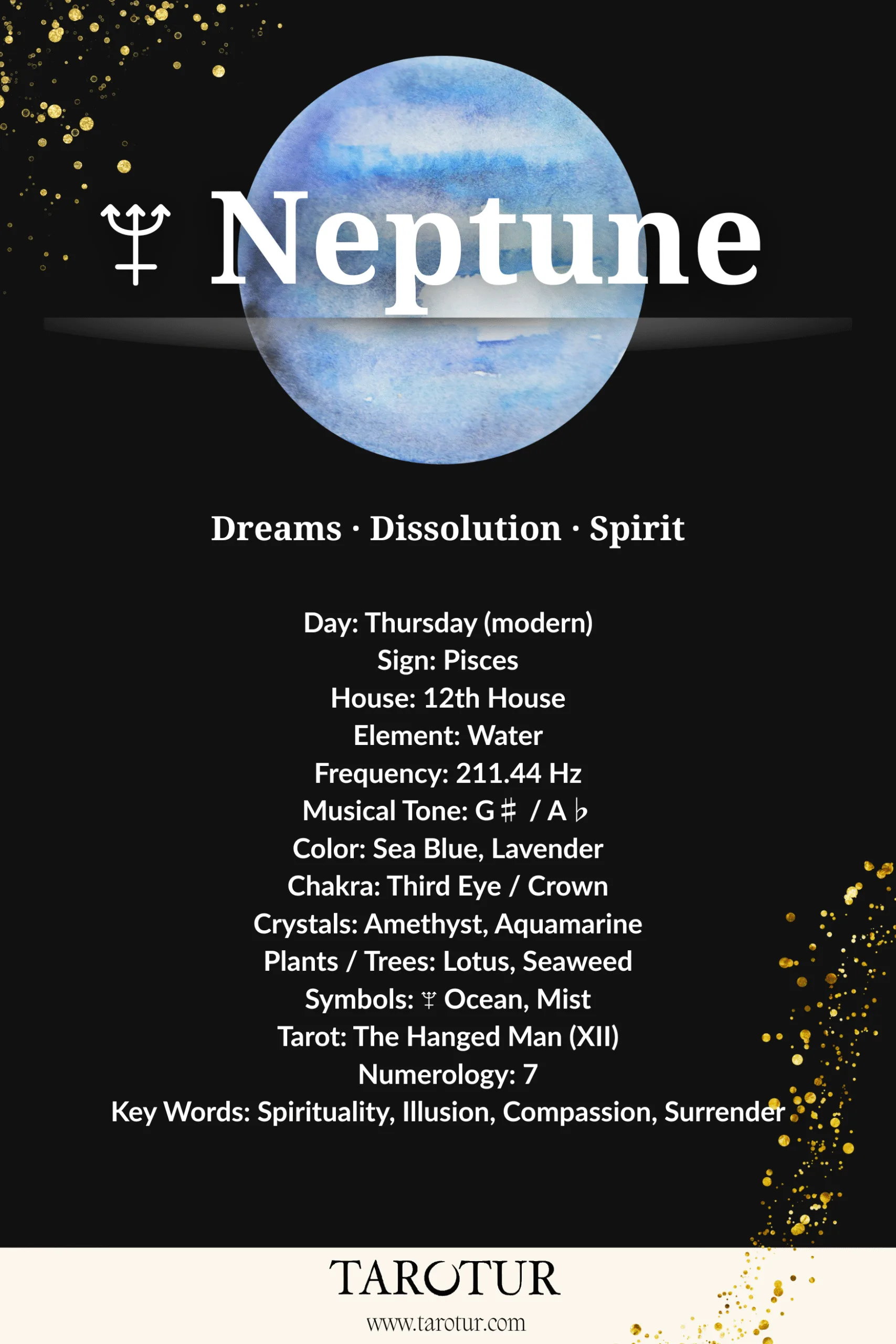
Neptune (Poseidon) is the mystic, the dissolver, governing intuition, dreams, spirituality, compassion, and creative fantasy. Neptune blurs boundaries, facilitating transcendental experience and connection to the universal source. It is the yearning for unity, the principle of divine love, and the realm of the collective spiritual unconscious. However, poorly integrated Neptunian energy manifests as escapism, delusion, addiction, and martyrdom, as the ego seeks to avoid harsh reality by retreating into illusion.
Pluto (Hades) is the planet of profound transformation, death, rebirth, power, and the deepest secrets held within the psyche. It governs the shadow, complexes, and unconscious compulsions. Pluto insists on purification and the total dismantling of anything that inhibits soul evolution. Its transit through a sign signifies collective trauma and renewal (e.g., the breakdown and restructuring of institutional power). Individually, Pluto deals with deep psychological integration—the confrontation with one’s shadow material to reclaim inner power. This journey is often painful, but the resulting empowerment is absolute.
- Uranus Keywords: Revolution, Change, Innovation, Freedom, Rebellion, Higher Mind, Individuality, Breakthroughs.
- Neptune Keywords: Spirituality, Dreams, Illusion, Dissolution, Compassion, Mysticism, Escapism, Universal Love.
- Pluto Keywords: Transformation, Power, Death/Rebirth, Shadow Work, Elimination, Obsession, Psychological Depth, Karma.
Conclusion
The planets in a birth chart act as a cosmic map of potential, illustrating the fundamental forces and archetypal dramas unfolding within the human spirit. By acknowledging the solar principle of identity, the lunar pulse of emotion, the Mercurial dance of intellect, the Mars/Venus drive for engagement, the Jupiter/Saturn lessons of societal integration, and the transpersonal evolutionary mandate of Uranus, Neptune, and Pluto, we gain mastery over our psychological landscape. Astrology is ultimately a profound tool for self-reflection, offering the language needed to understand our emotional patterns and align our personal will with the vast, cyclical currents of cosmic intention. Integrating these archetypal energies is the essence of becoming a whole, conscious, and spiritually mature individual.
FAQ: How do the planets influence my daily life?
Planets influence daily life primarily through transits—the movement of the planets now relative to their positions at your birth. These transits activate specific archetypal lessons associated with the planet, prompting shifts in behavior, emotional focus, or external events relevant to the house and sign being affected. For example, a Mars transit might bring energy to start a new project or trigger a confrontation, depending on its aspect.
FAQ: What is the difference between ancient and psychological astrology?
Ancient astrology focused heavily on prediction, external fate, and tangible outcomes (health, wealth, marriage, death). Psychological astrology, pioneered largely in the 20th century, shifts the focus inward, viewing the chart as a map of the psyche. Planets are seen as internal energies or sub-personalities (Jungian archetypes), and difficult aspects are understood as internal conflicts that require awareness and integration rather than unavoidable external misfortune.